
Foresight Is a Form of Stewardship

Who Gets to Shape the Future?
Organizational Foresight Is a Form of Stewardship
An AI adoption decision, a growth strategy, or a business turnaround begins before you write the plan. Even before the strategy design kick-off, leaders choose what deserves attention and whose knowledge they trust. Those early judgments shape organizational foresight: what the organization can see and, eventually, which options or risks it is willing to take.
I began to understand this years ago, while working on BASF’s 150th-anniversary co-creation initiative. The company used the milestone to open a global conversation about the decades ahead. Through Creator Spaces—captured in the film Experiment 150—employees engaged with scientists, policymakers, NGOs, environmental advocates, urban thinkers, and members of civil society, including people prepared to challenge the company’s assumptions. They worked together on questions involving food, smart energy, and urban living.
Perspectives from outside the usual corporate channels changed how the company understood those questions. People close to a problem saw realities that were less visible from the center. Institutional experts could connect those experiences to a wider business ecosystem. Some of the strongest insights emerged where the perspectives met, opening possibilities that no participant had recognized alone.
In our co-creative strategic experiment, senior leaders still made the decisions, while opening their perspective to make space for foresight and insight beyond organizational capacity.
Today, the tension between agency and adaptation appears in almost every organization-wide transformation. Artificial intelligence is changing work while expectations of employers, geopolitical conditions, and pressures on social and environmental systems are also shifting. A technology decision can affect trust, service, roles, and organizational identity at the same time. The knowledge needed to understand those effects spans functions, institutions, communities, and generations, yet leaders often must act before the full pattern is clear.
A wider field of view asks more of leaders. They must decide whose experience matters, how to weigh conflicting signals, and when the organization understands enough to move ahead with operational excellence. Participation gives executives more to work with. Like systemic team coaching, participatory approaches can also surface team and organizational blind spots that decision-makers alone may not see or anticipate.
In a more recent work on the 2026 ICF Coaching Futures Report: Expanding Access in Coaching, I realized that organizational foresight is a form of stewardship. When leaders consider whose knowledge could improve a decision, who will live with its consequences, and what the organization may strengthen or erode over time, foresight then becomes part of how they use power and authority.
This kind of thinking and commitment to open listening takes practice. In coaching, executives and leadership teams can learn how to stay receptive to emerging perspectives. Teams can learn to work with dissent, hold a paradox, and leverage polarities for growth instead of being hijacked by them.
In my recent conversation with Anne Schweppenhäußer for the ICF Foundation’s Purpose, People, Progress podcast, we explored the connections among deep listening, social impact, futures thinking, and the expanding reach of coaching. Society will continue to change with or without our participation. For leaders, the question is how deliberately they will take part and how much wisdom they will allow to influence the direction.
Before your organization commits to its next major course of action, whose knowledge could still change the picture?
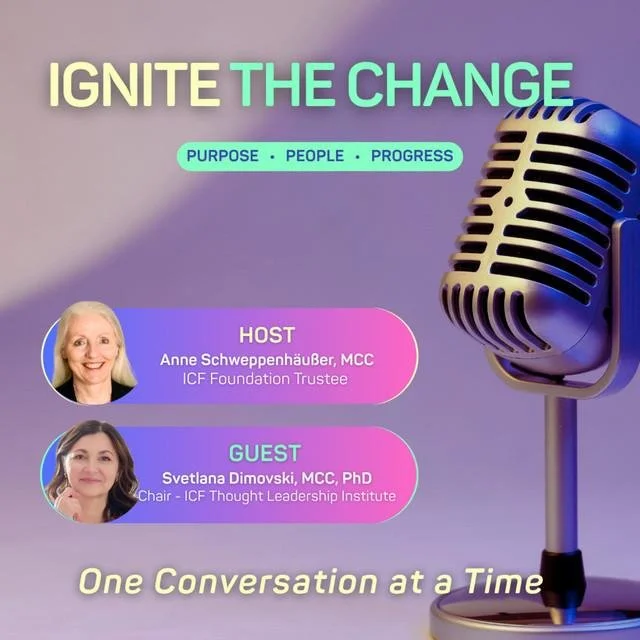
A conversation with Anne Schweppenhäußer for the ICF Foundation’s podcast.
